
Choose a Dental Office with a CBCT | Advanced Rochester Dentist
Choose a Dental Office with a CBCT
Technology around us is ever changing – even in the world of dentistry! Gone are the days of film processed dental x-rays that were uncomfortable and took time to process. Today we now have dental x-rays that are digital, are instantly processed and shared, and use less radiation. The common challenge with traditional dental x-rays is that they only show teeth and bone structures in two dimensions – this sometimes leads to not being able to see the full picture.
At Med City Dental, we believe that seeing the full picture is important to achieve the best treatment outcomes and have a solution for this two dimensional problem!
Did you know that now there are 3-D dental imaging available?
CBCT stands for Cone Beam Computed Tomography which allows for detailed three dimensional images. Dr. Scott A. Funke has invested in CBCT dental imaging that give a more detailed three dimensional image with lower radiation exposure than a traditional full mouth x-ray series. Realize that not all CBCT units are the same. The CBCT unit that is used at Med City Dental is one of the safest units on the market and uses the lowest radiation exposure and finest detail of any dental unit on the market. Our unit only requires a single pass to create a detailed image. Other units on the market require multiple passes that requires additional computer processing to “stitch” the separate passes together – leading to possible distortion and lower image quality.
Is getting a CBCT image painful?
Creating the CBCT image is quick, painless, and safe. Patients can either sit or stand for the creation of the image. Two quick scout images are made to ensure proper placement in the machine – eliminating the need for retakes. The whole process takes about a minute or less to do and less than 10 seconds of radiation exposure. Most patients express the better comfort and convenience of the CBCT compared a traditional full mouth series of x-rays that requires a sensor to be placed inside the mouth. Dental CBCT units use significantly less radiation than medical CT units that require higher levels of radiation. This reduces the overall radiation exposure and risk vs benefit of making the image.
What can be seen with a CBCT?
CBCT imaging allows for viewing more than just the teeth. The field of view (FOV) used on our CBCT allows for screening of the sinuses, nasal passageway, TMJ, airway space, upper and lower jaws, and teeth in a three dimensional view. This allows for more accurate diagnosis and earlier treatment of concerning pathologies. The unit can also be used for smaller, more focused areas if needed for evaluating a specific area of concern. This allow for the lowest possible radiation exposure necessary.
Can the CBCT screen for sleep and airway concerns?
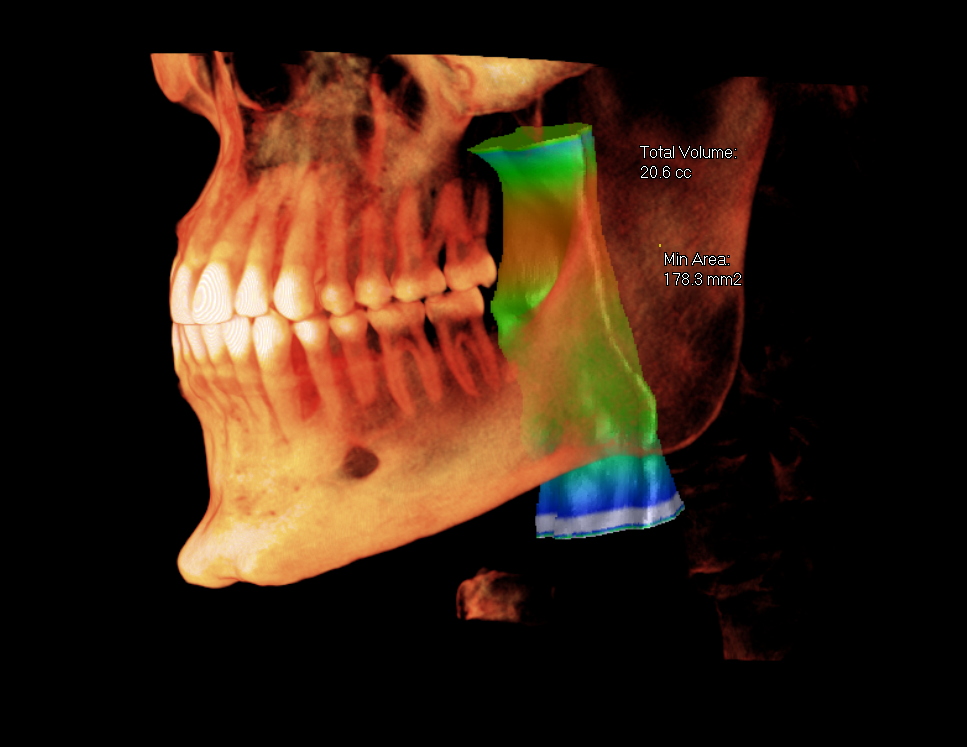
Imaging of nasal passage, sinuses, and airway space allows for better screening and treatment for sleep apnea. Sleep apnea is a serious medical condition that can lead to hypertension, metabolic syndrome, daytime fatigue, and premature death. CBCT imaging allows for earlier screening and treatment. Our software allows for screening of the airway space and volume. This also can be used for evaluation of oral appliances and effectiveness in opening the airway.
How can the CBCT be used for TMJ/TMD treatment?
Dr. Funke is also trained to treat temporomandibular joint disorder (TMD) – commonly known as TMJ problems. The CBCT imaging allows for more advanced imaging of the fossa, joint space, and condyles. This allows for screening for joint degradation and discrepancies of the right and left sides. It can also be used to for evaluating oral TMD appliances and splints.
Is a CBCT needed for implant placement?
Other advanced benefits of the CBCT is that it allows for digital implant planning for both single and multiple units. CBCT imaging is soon becoming the standard of care when planning implant treatment. Vital structures like nerves, sinuses, and tooth roots can be clearly seen and accounted for during the planning process. The CBCT also gives an image of the bone density for implant placement. The digital image can also be combined with a digital intraoral scan of the teeth to use during the fabrication of a surgical guide for implant placement. This takes out any guesswork for a more predictable placement and outcome.
Can CBCT help with teeth and wisdom tooth extractions?
Dr. Funke also offers tooth extractions and wisdom tooth removal in our office. The CBCT imaging allows for better visualization of the teeth and vital structures like the sinuses and nerves. Impacted teeth can now be seen in three dimensions. Better visualization leads to better treatment planning which in turn leads to better treatment outcomes.
How can CBCT help with endodontic treatment?
CBCT imaging also provides better imaging and diagnosis of more advanced endodontic issues. This allow for better interpretation of advanced infections, root fractures, root resorption, and canal location. Many teeth have multiple canals that can be more difficult to see on traditional x-ray images. In order to have the best possible treatment outcome, all canals must be located and treated properly.
Most oral surgeons and specialists utilize CBCT technology. Don’t you want your general dentist to do the same?
Learn more about our advanced dental technology here!
Comments are closed.